Targeted Summer Learning to Strengthen Skills & Build Confidence
How to Help the Unorganized Writer
We often hear teachers and parents asking about students who can clearly express their thoughts in words, but have difficulty translating them to the written word. These students can verbally answer a question, but when they write their thoughts down, it is not cohesive, and the point is lost in the rambling. Where is the “disconnect?”
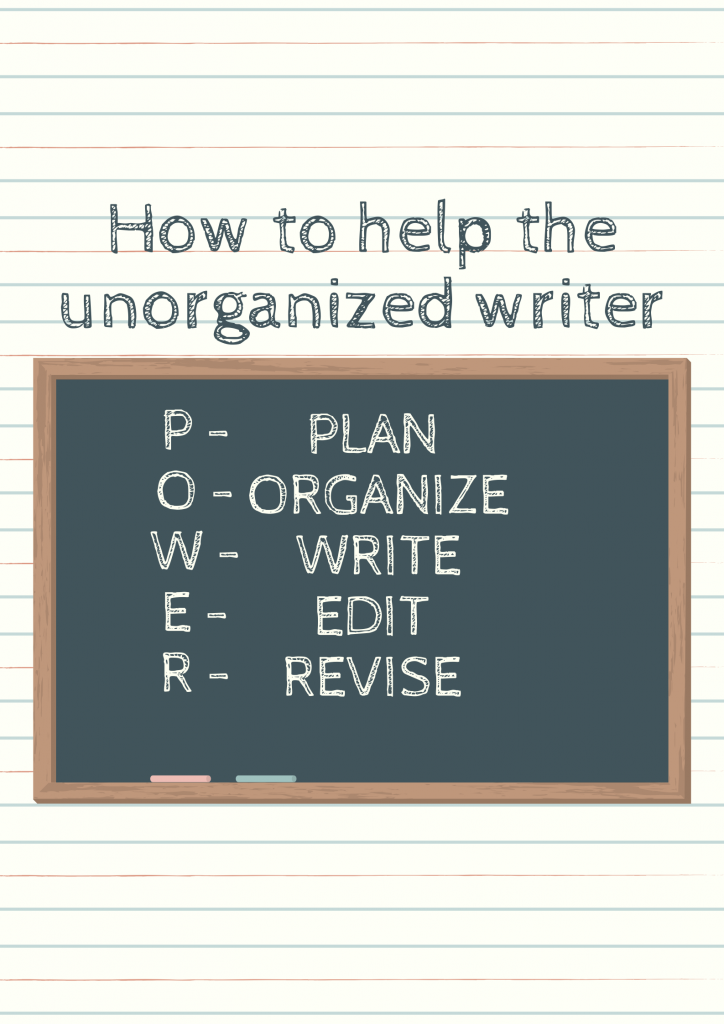
In general, this type of student has good ideas, but they are just unorganized. When having a conversation, ideas can flow a little better than when they need to be put on paper. Going immediately from talking about something to a blank page can be a huge mistake for most writers. Even very skilled writers generally don’t skip the planning and organizing stages; they may just do it in their head. Most students need a more concrete or visual plan before writing. While most students are taught this when they learn the writing process, it often just seems like an extra step to create more work. However, the planning and organizing stages can make the writing and editing go significantly faster. The POWER acronym for writing is an effective one to use with students.
P – plan
O – organize
W – write
E – edit
R – revise
The type of student we are talking about is one who goes straight from planning to writing. Organizing is an essential step and can happen in many ways. Here are some ideas:
Sticky Notes – write important ideas or details on sticky notes and arrange them to create a natural flow from point to point.
Outline – a simple numbered or lettered outline is a good strategy to collect ideas that are related, which makes it easier to move forward into building paragraphs.
Graphic Organizers – search “writing graphic organizers,” and you will find tons of examples like planning webs and templates that cater to any type of writing.
Formal writing continues to be an important skill, especially since more correspondence occurs through email and many students engage in so much informal writing through social media and texting. Encourage students to spend more time planning and organizing on the front end, which should help “writer’s block,” as well as papers that meander to their point.
Does your unorganized writer need (more) help?
For more information about our writing lab, please contact one of our two Learning Lab locations, or fill out the form below!
Learning Lab Brentwood
5500 Maryland Way, Suite 110
Brentwood, TN 37027
615-377-2929
Learning Lab Nashville
2416 21st Avenue South, Suite 100
Nashville, TN 37212
615-321-7272
Contact Us
Schedule your in-person visit or phone consultation today!
__________
“Power.” The Learning Toolbox. James Madison University, n.d. Web. 29 Sept. 2015. <www.coe.jmu.edu/learningtoolbox/power.html>.
Manage Consent
To provide the best experiences, we use technologies like cookies to store and/or access device information. Consenting to these technologies will allow us to process data such as browsing behavior or unique IDs on this site. Not consenting or withdrawing consent, may adversely affect certain features and functions.
Functional
Always active
The technical storage or access is strictly necessary for the legitimate purpose of enabling the use of a specific service explicitly requested by the subscriber or user, or for the sole purpose of carrying out the transmission of a communication over an electronic communications network.
Preferences
The technical storage or access is necessary for the legitimate purpose of storing preferences that are not requested by the subscriber or user.
Statistics
The technical storage or access that is used exclusively for statistical purposes.The technical storage or access that is used exclusively for anonymous statistical purposes. Without a subpoena, voluntary compliance on the part of your Internet Service Provider, or additional records from a third party, information stored or retrieved for this purpose alone cannot usually be used to identify you.
Marketing
The technical storage or access is required to create user profiles to send advertising, or to track the user on a website or across several websites for similar marketing purposes.